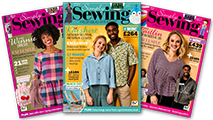



Get the new Great British Sewing Bee book worth £30 when you subscribe to Simply Sewing magazine
Your wardrobe Is failing you and it’s not because you lack clothes, but rather that you probably own too many. Here’s how to fix that.

A fabric marker is an essential piece of any sewing kit and we’d definitely recommend having at least one of them in your craft stash – you’ll be surprised how often you need them.
Fabric marking is used for a whole host of stitching techniques, ranging from dressmaking to embroidery.
There are many ways to mark fabric, and a wide choice of marking pens and pencils available. Choose a type that will work with your project and the kind of fabric you’re planning on using.
If you’re looking to buy fabric markers, make sure you check that they’re the right kind before you buy them. Fabric markers for sewing are not the same as fabric markers designed for decorating your textiles – if you use the wrong type, the marks may be permanent!
It’s important to test your marker on a scrap piece of your chosen fabric to make sure the marks can be removed, as they all react differently to different fabrics.
Remember to read the directions carefully so you know how to use them and, most importantly, how to erase them. Don’t press the marks before you wash them out or before they vanish, as this can often fix them in place!

Looking for more helpful info to help you on your sewing journey? You’ll find plenty in our sewing for beginners guide.
Fabric markers and chalks are useful for transferring sewing pattern markings, as you can draw the notches, dots and dart placements straight onto your fabric.
Although some sewists prefer to tack the markings or snip the notches, using a chalk pencil or water erasable pen or pencil is a much quicker method.
You can copy them straight from your pattern before you unpin it from your fabric. You can also add seam allowances to patterns that don’t include them by drawing the seam allowance outside the edges of the pattern.
Drawing quilting lines onto your fabric before you start sewing is a very effective way to ensure your stitching is spot-on.
A water erasable or chalk pencil is the best choice, as the marks will remain until you are ready to remove them. An air erasable pen will disappear too quickly, while iron-on transfer pencil marks are permanent.
Transfer pens and pencils are perfect for embroidery, as you can stitch over the transferred design. Iron-on transfer pencils are ideal for this, but they are permanent so make sure your stitching covers all the marks.
Another method is to tape your design and fabric onto a light source such as a window, then trace over all the lines using a chalk pencil, water erasable pen or pencil. Once the embroidery is complete, these lines can be removed.

Explore our best sewing machines for beginners and how to use a sewing machine guides.

These fabric markers are designed to be removed from fabric either by wiping with a damp cloth or by washing – some kinds of fabric pencil can simply be rubbed away.
They’re available in a choice of colours, so pick one that shows up on your fabric. For example, on a dark fabric a white fabric pencil would work perfectly. Some of the pencils also come with a brush on the end, which you can use to remove lighter markings.
Be aware that some fabric pencils crumble easily, so don’t press too hard when you’re drawing with them. You may also need to sharpen them again to keep the lines crisp when you’re working on a larger project.

Water erasable pens work in the same way as the pencil but come in a fine or normal tip size. They slide across the fabric more easily than a pencil and you can buy them in a variety of colours.
The marks can be sponged or washed off and some pens come with an eraser at the other end.
Many water erasable pens are also air erasable, meaning that the marks will disappear by themselves after a short period of time – even if you don’t wash them away. Check the packaging to see how long the marks will remain visible for if you’re working on a time-consuming project.

The ink in these air erasable pens is specially formulated to stay visible for a few hours, but the time does depend on the brand of pen and the type of fabric you’ve marked it onto. Some will stay visible for a few days.
Air erasable pens are great for speedy sewing projects, as you’ll have completed the pattern before the marks fade away.
These pens come in different tip sizes, and some varieties can also be removed with water. They are also available in an array of different colours, so you’ll be able to find the right one to suit your project.

Chalk compressed into pencil form, these are a really convenient and clean way of marking your fabric.
They rub off quite easily, which is great for quick removal but can mean that you can accidentally rub away your lines whilst working. Sharpen these pencils often to keep a fine point.
If you like using chalk pencils, you might also find it useful to buy some tailor’s chalk too. It comes in neat triangular blocks which don’t need sharpening. Chalk pencils are essentially tailor’s chalk in pencil form.

Iron-on transfer pencils are ideal for intricate embroidery designs as they can be used to reproduce fine details very clearly. Sharpen your pencils regularly to keep your lines looking crisp.
Unlike water or air erasable fabric markers, transfer pencils won’t disappear quickly. However, they are usually permanent, so make sure your stitching covers all of your transferred lines.
To use iron-on transfer pencils, simply draw the pattern in reverse onto tracing paper, then iron it pencil-side down on top of your fabric and the image will transfer.

It’s best to sharpen your pencils using a specialist sharpener, as it won’t damage the soft tip and you will keep a sharp, fine line. This is very important when you’re working on a project that needs to be precise and accurate – or if you’re working on a complicated embroidery design.
Fabric erasers will remove light pencil marks and eraser pens, used for quick removal of marks from water erasable pens, can be really useful, too.
These are both optional extras to have in your craft kit, but they can be very handy to have – just in case.

Love the GBSB? Want to know the latest news or read about previous series? Check out our guide to The Great British Sewing Bee
Once you’ve chosen your preferred fabric markers (or have stocked up on all of them), looking after them will help them to last longer.
Always keep lids on pens when you’re not using them, especially the air drying ones to prevent them from completely drying out. Try to avoid dropping your pencils too – keeping them in a pot or shirt pocket will make it less likely to accidentally roll them off the table while you’re adjusting your fabric.
Now that you know all about fabric markers and which ones to use, check out our guide on How to trace sewing patterns and start prepping your projects like a pro!


Never miss an issue! Sign up to receive your favourite magazine every month – delivered straight to your door.
Sign up today