



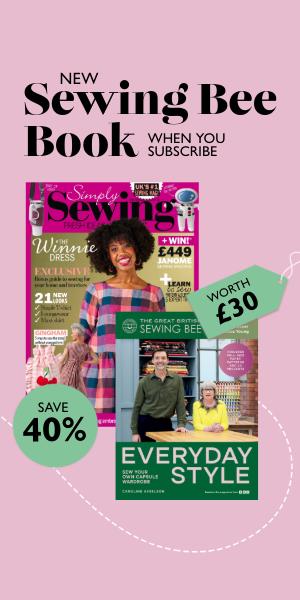
Get the new Great British Sewing Bee book worth £30 when you subscribe to Simply Sewing magazine
Meet Bella Mae, a costume crafter who fell in love with film fashion and now devotes her career to reinventing these iconic looks

Colonial knots have a raised, textured appearance and can be sewn individually or in clusters, making them ideal for stitching floral motifs.
Sew colonial knots using three shades of pink to stitch delicate blossoms with our step by step guide to this clever embroidery stitch. Download our free template below as a positional guide to where to place your knots. Trace the blossom embroidery pattern onto the fabric.
If you’re working the design above, add the words, branches and birdcage in backstitch. Template design by Lisa Jones stitching and instructions by Rebecca Reid
First, secure your thread on the back of your work through some of the already worked backstitches, close to where you want your first knot to be. Now bring the needle up at 1 and loop the thread over it.

Next, take the thread over and under the needle in a figure of eight. Follow the thread path on the diagram to see exactly how this is done. With time and practice you will get very quick at doing this.

Push the needle back down at 2, close to where it first emerged. Before you pull it all the way through, tighten the loops around the needle and hold them in place. Pull the needle through to form a neat knot.

The welcome sight of blossoms in bloom is a sure sign that winter is behind us and spring has sprung. Though the blossom season may be fleeting and it’s not long before those pretty petals float away on the summer breeze, you can make it last by stitching your own blossom tree onto
a plain make-up bag using colonial knot stitches. Download our free pattern above and use your new skills to embellish a plain bag with these pretty blooms.


Never miss an issue! Sign up to receive your favourite magazine every month – delivered straight to your door.
Sign up today