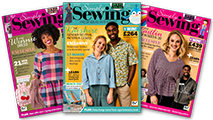



Get the new Great British Sewing Bee book worth £30 when you subscribe to Simply Sewing magazine
Meet Bella Mae, a costume crafter who fell in love with film fashion and now devotes her career to reinventing these iconic looks

The Sewing Bee is back and it’s better than ever. To catch up with the new series, head over to our Great British Sewing Bee guide, but if you want to learn more about the legendary Patrick Grant, then you’ve come to the right place.
We sat down with the one and only Patrick Grant to get all his thoughts and feelings about the latest series of the show. But first, discover more about Patrick’s sewing background…
Patrick Grant has been with the Sewing Bee since it began in 2013. He was chosen to judge alongside May Martin and later Esme Young, thanks to his experience in designing men’s fashion.
He was born in Edinburgh and studied at the University of Leeds and New College, Oxford. Before turning to fashion, Patrick was an aspiring rugby player whose rugby career was cut short by a shoulder injury.
He later moved to the US, where he worked in a surprising variety of jobs. His first job there was as a ski instructor, but he also worked as a nanny, camp counsellor, landscape gardener and model agent. He returned to the UK in 1995 to pursue a career in marketing.
In 2005, Patrick sold his house and car (as well as seeking loans from family and friends) to buy Norton & Sons, a struggling Saville Row bespoke tailor. He threw himself into restoring the 200-year-old business to its former glory and was able to turn its fortunes around.
Patrick went on to revive the E. Tautz brand in 2009 and acquired Cookson & Clegg in 2015, saving the 160-year-old business from closure.
He was awarded an Honorary Professor of Business from Glasgow Caledonian University in 2013 and was made a fellow of the Royal Society of Arts (FRSA) in 2016.
He is 53. Patrick Grant was born on 1st May 1972.
Patrick Grant is 1.9m (6″2).
Patrick is the owner of Norton & Sons and Cookson & Clegg, as well as the menswear label E. Tautz. He is the king of artisanal suits with an eye for detail and precision, which he brings to all his judging.
But it’s not just high-end tailoring that’s keeping Patrick busy; he set up Community Clothing to support ethical clothing manufacturing practices.
Patrick is also a supporter of HRH King Charles III’s charity Future Textiles. The charity aims to educate young people and sustain Britain’s traditional craft skills for the next generation.
All this and judging in our favourite TV show? How does he do it!
Now we’ve given you a bit of background on Patrick, have a read of our interview with him about the latest series of The Sewing Bee.
Here’s what the amazing Patrick Grant has to say about 2026’s Sewing Bee series…
How would you sum up series 12 of The Great British Sewing Bee? We hear there are innovations…
Series 12, goodness me. I keep forgetting how many it is. Yeah, we’ve thrown in some new stuff. In the past, every individual sewer has done every challenge on their own and we’ve only ever done challenges where they’ve had to make one of something. We just felt, because of that, there were things we weren’t able to set them, so we got permission to change the make-up of some challenges. Not in a big or complicated way, though. I’m delighted we did because it makes for some really, really brilliant challenges. Even in week one, there’s a change around how the made-to-measure is done.

The bees have to model their own creation…
It’s something a lot of people who make clothes at home have to do, so we thought it was a very real challenge and it kicked things off in a slightly different way. It worked extremely well because you saw a different set of skills and they made things in a way that felt more personal. We’ve also set them challenges where they have to work in groups – either small or slightly larger.
Why decide to do that?
In the professional world of sewing, a lot of stuff gets made by teams working together on fixed briefs. You have differences, but also continuity between pieces that get made. If, for example, you were making costumes for a pop group, one or two people would have the overall brief. Then, multiple makers would be involved in making to that brief things that go together, but aren’t necessarily exactly the same. Some of the biggest bits of professional sewing in the UK are around costume for film, television, pop groups and other performers in musical theatre or dance. And we’re really, really good at it. So we’ve dipped into that world to explore some of the challenges those makers face. It worked really, really well.
We’ve seen the sewers get better and better every year learning from those who’ve gone before. It seems almost redundant to ask what the standard is this time…
You’ve always got that framework of improving overall quality. It’s also that the pool of talent gets bigger all the time as more people sew clothes. You have more people who might think, ‘I could have a go at this…’ The other interesting thing is we’ve had individuals who are fantastically talented who haven’t necessarily won. The winners have always been people with extraordinary skills, but sometimes people with the most amazing vision don’t necessarily win. There might be a week that trips them up and they go out. Or they may not show their best work in the final because the challenges don’t entirely suit the things they’re best at. I can think of a couple of people who could’ve easily, if the challenges had fallen differently, won the whole thing. Again, this year, we’ve got a great mix of talent, but also some extraordinary vision. I think we’ve had the best person we’ve ever had. Well, I know we have. I’d hate to say whether they win or they don’t win, but sometimes people come on the show and you think: ‘This person has the most extraordinary talent.’ And if their life had panned out differently, you could’ve seen them being a very significant presence in our industry.
Goodness, they are good…
Ah, yeah. Wait ‘til you see it all, wait ’til you see it.
If someone’s like that, then it also lifts everybody else’s game, doesn’t it?
Yes. The tone gets set from week one. Funnily enough, I was watching Pottery Throw Down and the same thing happens there. That first week, so many people did so many brilliant things and everybody else has to really step up. Some people can’t. Some people don’t have the artistic vision. They may have skill, but they don’t necessarily have the creative flair to bring things that really, really light up the room. We had a lot of that. There were a lot of things that happened this year that just made everybody in the room stop and go: ‘Wow!’ I mean, I’m slightly welling up at the thought of some of them now.
You’re going to turn into Throw Down’s judge Keith, aren’t you? You’re going to start crying…
I’m going to turn into Keith. LAUGHS I think I did, actually, it was so overwhelming. What is so lovely is people who have very little idea about how brilliant they are, through this process of being challenged, reveal themselves to be extraordinary. And sometimes you get to a point where the penny drops. The penny often drops earlier with others in the room. Others will go: ‘Holy smoke. This person’s incredible…’ or ‘These people are incredible and I’m just making weight here.’ The other sewers and Esme and I will see it and they might not. What you hope is that, if they don’t have a mishap, you get to a point where, after 10 weeks, they know how good they are. And that is a wonderful thing to be part of.
When they realise, that must give them such a boost in confidence and vision…
Yeah, yeah, yeah. A lot of people that have been on the show wouldn’t necessarily have thought this might be a life-changing, career-changing thing. But actually, occasionally, there are people where it has happened. What is great in life is when your passion matches your talent and you can build a life around that.
Were there many divergences of opinion between you and Esme this year?
The usual amount. LAUGHS We do have differences of opinion on quite a lot of things. There are things Esme feels really strongly about and things I feel really strongly about that aren’t necessarily aligned, but they’re valid. That’s why there are two of us judging.
Nobody ends up sporting a black eye?
Well, it’s a long way up from where Esme is to pop me. LAUGHS Happily, she hasn’t found a stepladder. Ultimately, we always manage to reach agreement. Occasionally, there needs to be a bit of arbitration. Occasionally, we have to resort to scoring things in a somewhat numerical way just to get through some impasses. We’re like: ‘OK, out of 10, what would you give this?’ Then it’s: ‘You’ve given it a six, but I’ve given it a nine…’ so it’s an average. But, you know, most of the time it’s reasonably easy.
Tell us about this year’s bees…
They’re 27 to 64, so nobody particularly young and nobody particularly elderly. We’ve a classical soprano. That was pretty interesting.
Did she sing you anything?
Yeah. LAUGHS She did a brilliant rendition of Pink Pony Club… she chucked in a bit of Chappell Roan. It sounded amazing. I don’t know if it was on camera or off. Esme is a big opera fan, so she was loving that. We had a female PhD engineering student. We had somebody who worked on what I think they call a care farm. It’s basically a mental health, engagement with animals, come-and-stroke-the-donkey-and-feel-better kind of farm. We had a barista, a couple of teachers… a great cross section.
They always have quite different styles, don’t they?
There were people with a very clear aesthetic. Some of that was quite simple and some unique. Obviously, some challenges allow you to play to your own personal taste, some don’t. Sometimes that does trip them up. Some people are trying to shove a square peg in a round hole and it tends not to work. It tends to be their undoing. In some challenges, you have to leave behind your own predisposition towards a particular aesthetic.
In the transformation challenge for Colours and Prints Week, they had to give life to the judges’ most hated colours. Yours is purple and Esme’s is brown…
Oh yes. *LAUGHS* It was an interesting idea and the success of that challenge required us to suspend our own dislike of those particular colours. You’ll see how well that turns out. One of the judges managed better than the other, let’s put it that way. You can safely say neither of us have discovered a new passion for these colours. LAUGHS But one of us was a little more firmly rooted in their prejudice.
The pairs challenge in Sports Week asked them to transform windsurfing sails into a two-piece, while the Music Week team challenge was using bedroom textiles for costumes for a pop trio. Tell us more…
Well, the brief wasn’t to make for a specific group and they didn’t necessarily have to pick a real band, but they had people in mind. In that challenge, it was three of them in the team and they knew each other reasonably well by that stage. They knew each other’s strengths and weaknesses. They knew who might have the clearest creative ideas. I haven’t seen this process, obviously, so how they arrived at the choice of band aesthetic, I don’t know. And I don’t know how easily they did that – you will find out the same time I do.

What were you looking for?
To be successful, they had to pull together something that felt like a group of outfits pop stars would wear, had a clear unifying aesthetic and was kind of cool-looking. And they did. The results were really good. In the pairs challenge, they did half the outfit each, whereas in the band challenge, they did one pop star each. It was colour and aesthetic and maybe fabric that pulled it together, but there were variations in line with the way there are different characters in bands. You know, in the Spice Girls, one was the sporty one, one was the posh one. In the pairs challenge, they were both made of the same sail. Colour-wise, they might have been the same, but they’d also got to be stylistically the same, so it feels like a cohesive outfit. They really enjoyed the challenges. It often feels like fun in the transformation, but it felt even more fun.
What were your favourite pattern challenges?
Well, knickers was good in Reduce, Reuse, Recycle Week. They had to make multiple pairs. That was fun.
They’d be OK working at Underworld in Coronation Street…
Well, they could come and work in our underwear factory in South Wales for Community Clothing. The Madonna-inspired cone bra was a good challenge in Music Week, too. Esme claims she did that long before Jean Paul Gaultier. *LAUGHS*
Let’s hope Madonna is in London when it airs and sees the show…
I hope so, yeah. The deerstalker challenge was good in Literary Icons Week.
Not many people make deerstalkers these days…
Not many places left doing it, no, but it’s a really good challenge. I don’t think any had done anything like it before. And because of the way the deerstalker works, it’s symmetrical in two directions. Both side flaps have to be perfectly matched and both peaks have to be perfectly matched, so it’s a difficult thing to pull off. You can see instantly whether they’re good or not. They managed very well.
What about favourite transformations?
Well, the windsurfing sail challenge did work really well. The stuffed animals made from fleeces were amazing… That’s not an item of clothing, but in a funny way, we’ve gone part the way there with the kids’ fancy dress. Pascha did that amazing dinosaur or alligator costume in 2024. The amazing bit of that costume was the headpiece – effectively a stuffed dinosaur head. And that created the idea behind doing this. I’ve got a friend, Christopher Raeburn, a menswear designer. For years, he made brilliant stuffed animals out of the spare fabrics in his studio: squirrels and all sorts. People really loved them. That was a really good challenge. Also, a lot of fleece gets thrown away. It’s got a hefty carbon footprint and you want to give it another life. There’s quite a bit of stuffed animal appropriate fabric in one of those things. There were really cool ones.
What else?
The Mexican oil tablecloths turned into structured garments worked really well in Mexico Week. I don’t know if you remember, but we did art canvases the first year we did Art Week. Oil tablecloths are a very tricky fabric, too. You’ve got to have a good idea about how to use that stuff. There were fantastic versions.
What were your favourite made-to-measures?
The embroidered and appliquéd bowling shirt in Sports Week produced one of the coolest things we’ve ever seen on the show. Several people did really great versions. That was an absolute standout. And I really enjoyed Literary Icons Week. That’s new. The made-to-measure that week was an outfit inspired by Jane Austen. We weren’t looking for period costume, we were looking for details you could bring into something contemporary. They managed extremely well. By the time we get to week eight, there are pretty extraordinary items. All of those challenges were very difficult to judge.
Did they dress you up Mr Darcy-esque and get you to emerge from the Leeds & Liverpool Canal?
Erm, no. They missed a trick on that one, didn’t they? *LAUGHS* You know, Matthew Macfadyen emerging from Rodley Lock. They should have… Actually, there is a mill pond just behind the set, but it’s somewhat full of sludge. And ducks.
It wouldn’t have had the same effect if you emerged like a green monster…
No! *LAUGHS*. I’d have ended up looking like the bookends creation that won in week two of Pottery Throw Down this year: the green merman with the fish and the tendrils…
Mexico Week was another newbie. Did you have lots of homages to artist Frida Kahlo?
Actually, we didn’t. We stuck very much to traditional Mexican themes. The folkloric top – the pattern challenge – is classically Mexican. You probably would have seen Frida Kahlo wearing some of those, but it wasn’t a particularly Frida Kahlo-y challenge. The oil tablecloths were brilliant – everybody uses an oil cloth in Mexico when they eat out and eat in. They’re so colourful and so structural. And the final challenge was lovely. We asked them to make an outfit inspired by a Mexican festival. We’re used to seeing the Day of the Dead Festival – that’s become a big deal in Northern Hemisphere Western culture, but there are so many festivals. Every little town has its own with their own stories. It’s a little bit like in the UK, where these odd folk festivals are re-emerging as people try to re-establish connections to history and culture and community locally. They each had to pick a festival. It could’ve been from anytown anywhere in Mexico – a huge country with enormous cultural differences. The research they did, I know they really enjoyed. It really was supposed to be accurate. And Erika Alvarez – our great guest judge – is very knowledgeable. It is really, really fun for Esme and I in international weeks because we learn a lot. It’s been such a nice part of the show over the years – our ability to dip into the history of different clothing cultures. I’ve been to Mexico once, but only to a tiny little corner. I’d really like to go and do it justice.
What about the final?
They were really good. I feel like they will all come away from that final feeling like they gave a great account of themselves. Sometimes that’s not the case, but in this instance, it definitely is. They will all feel they’ve done everything they could do. The winner was clear…

You’ve got a new host: Sophie Willan. How much fun did you have?
I’ve been a massive fan of hers. I watched Alma’s Not Normal when it first came out and then I watched it again. Then, I watched it a third time before I watched the second series. It’s absolutely brilliant. Sophie is an extraordinary talent. She’s a brilliant actress and she’s naturally incredibly funny, but she’s got such a big personality. She’s really forthright. We’ve had quieter hosts and more gregarious. She’s very much in the latter camp and brought a really big energy to the room, despite being very pregnant towards the latter end. We were getting quite close to her due date, so it’s an amazing feat of stamina to get through it all the way she did. She never failed to bring massive energy to the moments where she needed to bring massive energy. And the sewers loved Sophie. We’ve been very lucky. We haven’t had a single host that hasn’t been great with the sewers. She’s there to bring the energy and the lols. Also, you know, she’s got three BAFTAs and not just for something she’s been part of, but for something she personally created. Getting to work with her is really a privilege. It just makes our job easy. Esme and I loved working with Sophie. She’s a great addition to the team. We’ve been blessed by having brilliant people working with us on Sewing Bee all the way through.
Have you and Esme ever made something for each other?
Well, I have, but I didn’t sew it myself. I designed it and it got made by my team at Cookson & Clegg and it’s now something we sell at Community Clothing. It’s called the Esme shirt. It was inspired by a dress I’d seen Esme wearing. I really liked a pocket she’d done, so we did a shirt version. She wears it quite a lot.
It’s not brown…
It’s certainly not brown. It’s blue and white. There’s a picture of her in it on the Community Clothing website.
Do you ever transform anything in your wardrobe?
No because I designed pretty much everything in my wardrobe in the first place. *LAUGHS* I do quite a lot of fixing, though. I use a bit of backstage time on Sewing Bee as we’ve got all the interfacings, threads and machines there. I fixed five or six things last year – mostly trousers with rips. There was a really lovely pair I wear a lot that got snagged on some barbed wire, so I fixed those. Everything I have is exactly how I want it.
Any new projects? Are you doing a follow-up to your best-selling book, Less?
There’s been conversations about it, but nothing I’ve started. We’re going to be selling secondhand Community Clothing alongside new – that’s a big project for us this year. If you’re bored of your coral pink hoodie, you can send it back and we’ll give you some credit and resell it and you can have something different. I’m still doing my FT gardening column. There’s lots happening on the house and garden. I’m just looking at a wasteland of mud that the man with the big digger hasn’t been able to get onto because it’s been so wet. It was the same last year. We had four months of drought, then four months of endless rain.

If you’ve been eyeing up the machines on the Bee and want to know which model or brand they’re using, we’ve got you covered! Simply Sewing Magazine’s senior technical editor has tracked down what sewing machines are used on the Sewing Bee so you can order your own.
Patrick Grant is at the heart of the Sewing Bee – and he’s been judging the show since it first launched in 2013! Patrick brings a lot of personality to the show, and it’s easy to see how much his feedback matters to the contestants.
As well as adding warmth and wit to the show, Patrick has years of experience in men’s fashion, with a keen eye for tailoring and precision. He’s the owner of Norton & Sons and Cookson & Clegg, but he also established Community Clothing to support ethical clothing manufacturing practices.
We can’t wait to see Patrick back in the sewing room for the new series!
It wouldn’t be the Sewing Bee without our favourite duo: Patrick Grant and Esme Young! Esme’s fashion career has spanned 50 years, so she brings a wealth of knowledge and experience to the sewing room. She’s worked with several celebrities over the years, including Leonardo DiCaprio!
Get to know Esme Young with our fascinating interview.


Never miss an issue! Sign up to receive your favourite magazine every month – delivered straight to your door.
Sign up today